

Your Analytics Look Fine. So Why Is AI Recommending Someone Else?

Your Analytics Look Fine. So Why Is AI Recommending Someone Else?
You open Google Analytics. Traffic is steady. Bounce rate looks normal. No sudden drops, no alarming spikes. Everything, on the surface, looks fine.
So why did your potential customer just hire someone else?
Here's what traditional analytics will never show you: the moment a person opened ChatGPT, typed "who's the best [your service] in [your town]" and got back three names. None of them yours. They clicked the first result, booked a call, and moved on. You won’t see this action in your dashboard.
This is the invisible competitor problem, and it is happening to small businesses across the UK right now.
The rules of search have quietly changed. Customers are no longer just Googling. They are asking. And the AI doing the answering has already decided who to recommend, usually before your potential customer has even visited a single website.
AI Search Has Changed How Customers Find Businesses
For most of the last decade, showing up online meant ranking on Google. You built your website, maybe ran some social media, and hoped people clicked through. The funnel was visible. Trackable. Logical.
AI search works differently. When someone asks ChatGPT, Perplexity, or Google's AI Overview for a recommendation, the model does not crawl the internet in real time. It draws on everything it has already learned: your website content, third-party mentions, review signals, structured data, and how consistently your business is described across the web.
Then it produces an answer. A short one. Usually naming two or three businesses, sometimes just one.
“According to Forbes, citing Adobe Analytics data, AI-driven traffic to websites is projected to rise 130% year-on-year this holiday season alone, with visitors from AI sources staying 48% longer and converting at 42% higher rates than those from traditional search.”
That is not a small shift. That is a new front door to your business, and most small business owners do not even know it exists, let alone whether they are standing behind it.
The platforms your customers are already using
The AI assistants fielding these recommendations are not niche tools. They are mainstream:
ChatGPT now handles an estimated 500 million to 1.7 billion searches per day
Google AI Overviews appear in roughly 50% of all Google searches, projected to exceed 75% by 2028
Perplexity, Claude, and Gemini are each growing their user bases rapidly among professionals and consumers alike
Your potential customers are on all of them. The question is whether those platforms know enough about your business to recommend you.
Why Your Analytics Cannot See the Problem
This is the part that trips most people up. If business is a little slow, you check your analytics. Traffic looks fine. Conversions are roughly where they were. Nothing screams "fix me."
So you conclude everything is okay.
But here is what that dashboard is not measuring: the customer who never arrived. The person who asked an AI for a recommendation, got three names (none of them yours), and booked with the first one. That entire journey happened outside your analytics. No session was recorded. No referral source logged. No bounce to report.
Your data is accurate. It is just incomplete.
McKinsey's report New Front Door to the Internet found that only 16% of brands systematically track their AI search performance. The other 84% are flying blind, checking dashboards that were built for a world where Google was the only gatekeeper.
What the gap actually looks like
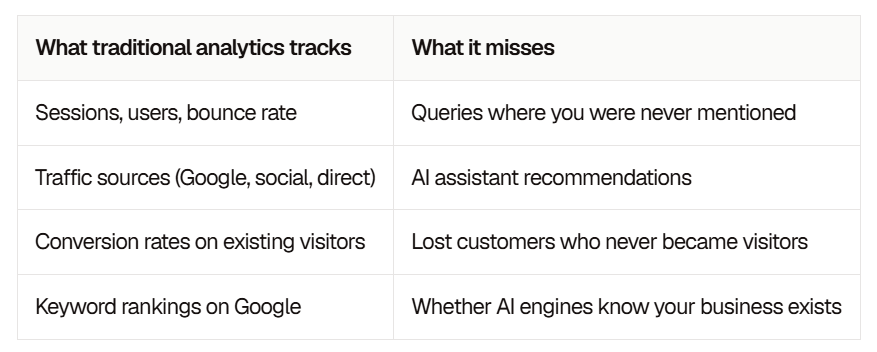
Table1: The Gap in Traditional Analytics
If you are only looking at the first column, you are measuring the health of the customers who found you. You have no visibility into the ones who did not.
Who Is Getting Recommended Instead of You
The businesses AI recommends are not necessarily the best in your field. They are the most legible ones.
AI models recommend businesses they can understand, verify, and trust. That means the businesses showing up in AI answers tend to share a few common traits:
Clear, structured website content that directly answers the questions customers ask
Consistent information across Google Business Profile, social media, directories, and their own site
Third-party mentions from credible sources: reviews, press, industry directories, local listings
Structured data (schema markup) that labels what they do, who they serve, and where they are in a format AI can read
None of this requires a big budget. It requires knowing what AI is looking for and making sure your business provides it.
The uncomfortable truth is that your competitor who keeps coming up in AI answers may not have a better service than you. They may simply have a more AI-readable online presence. They got there first, or they got help optimising for it.
Three Things You Can Do This Week
You do not need to overhaul everything at once. Start with these three checks to get a baseline read on where you stand.
1. Ask AI about your business right now
Open ChatGPT or Perplexity and type: "Who are the best [your service type] in [your location]?"
Then try: "Tell me about [your business name]."
What comes back? Are you mentioned at all? Is the information accurate? Does it reflect what you actually do and who you serve? Many business owners discover either that they are absent entirely, or that the AI has picked up outdated or incorrect information from somewhere online.
A survey of small business owners found that 40% of those who checked had already found incorrect information about their business in AI answers. That misinformation is actively shaping how potential customers perceive you.
2. Audit your consistency across the web
AI builds its understanding of your business by cross-referencing multiple sources. If your address, phone number, or service description differs between your website, Google Business Profile, and your social media bios, that inconsistency erodes AI's confidence in recommending you.
Check that the following match exactly across every platform:
Business name (including any abbreviations or trading names)
Address and service area
Phone number
Core services and how you describe them
3. Look at your website homepage as if you were an AI
Your homepage needs to answer four questions clearly, without the reader having to dig:
What do you do?
Who do you do it for?
Where do you operate?
Why should someone trust you?
If a customer (or an AI model) cannot answer all four within 30 seconds of landing on your page, your homepage is working against your visibility.
The Window for Early Movers Is Still Open
Here is the thing about AI search visibility that most people do not realise: we are still early.
Right now, the majority of small businesses have not optimised for AI at all. McKinsey's New Front Door to the Internet report projects that $750 billion in US consumer revenue will flow through AI-powered search by 2028. In the UK, the trajectory is the same. The businesses that establish their AI presence now, while most competitors are still ignoring it, will be the ones AI defaults to recommending when the volume really picks up.
That window will not stay open. Within two years, AI search optimisation is likely to be as crowded and competitive as traditional SEO is today.
The good news is that right now, getting ahead is still genuinely achievable for a small business without an enterprise budget.
If you want to know exactly where you stand, an AI Visibility Audit gives you a clear picture of how AI currently sees your business, what it is getting wrong, and what needs to change. It takes 48 hours, costs £97, and gives you a concrete starting point rather than more uncertainty.
Your analytics are not broken. They just were not built for this. The question is whether you find out what they are missing before your competitors do.
AI Visibility Audit
