

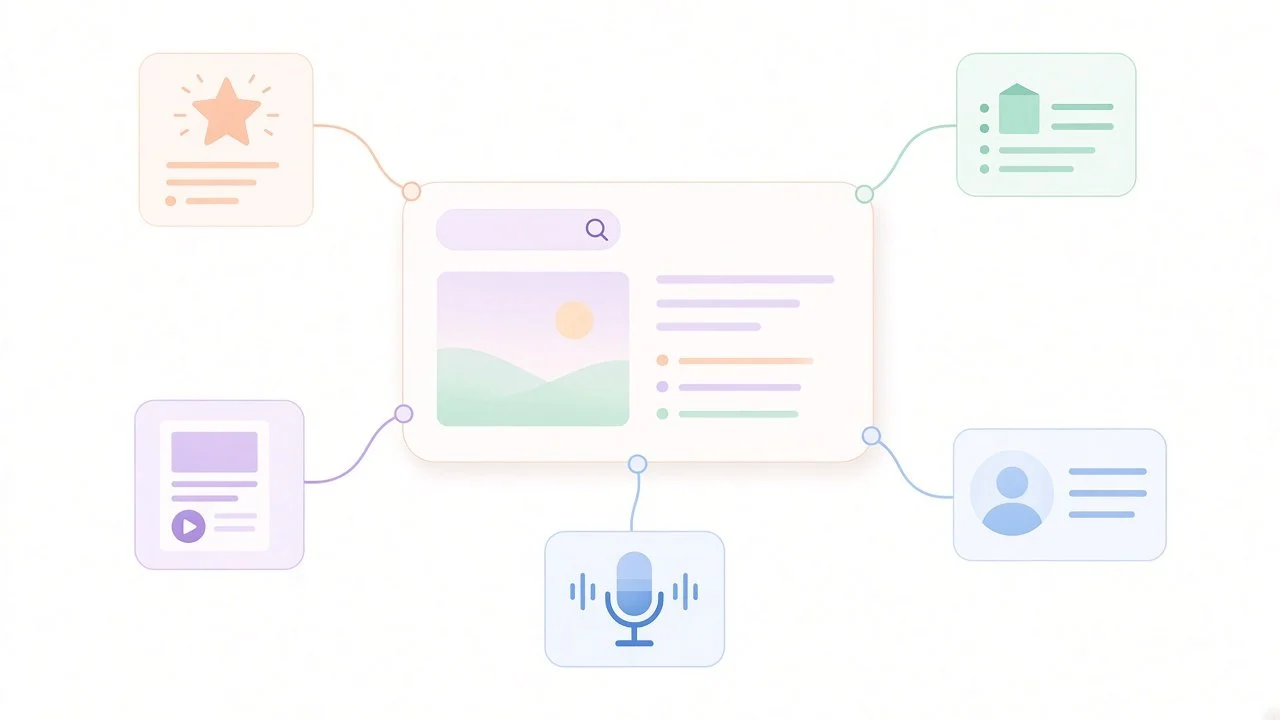
AI reads more than your website.
When a potential client asks an AI tool which HR consultant, private clinic or financial adviser to look at, it's tempting to think the answer comes only from your website. Often it doesn't.
Tools like ChatGPT and Google's AI Overviews can search the web and show links to the pages they drew on. Some of those pages may be yours. Others may be a review, a directory listing, a trade article or a LinkedIn profile. Searchable's recent webinar on PR, social and community made the case that AI answers lean heavily on what other people publish about a business. That's their view rather than a fixed rule, but it's a useful prompt to look beyond your own site.
What do AI tools look at when they describe your business?
There's no published list, and no tool promises to mention any particular business. But the official guidance gives some useful clues.
ChatGPT can search the web to answer questions with current information and links to sources. OpenAI's help centre says answers that use web search may include citations you can click to open the source, and that results "can be incomplete, outdated, or incorrect". It also says placement in its search results "is not guaranteed".
Google's AI Overviews and AI Mode show links to supporting websites. Google says the usual good practice for Search applies, and there are "no additional requirements" to appear.
Google's guidance on helpful content asks a telling question: if someone researched the people behind a piece of content, "would they come away with an impression that it is well-trusted or widely-recognized as an authority on its topic?" That impression is shaped by more than your own pages. It comes from what others say about you too.
Try this: a simple self-check
You don't need special software to get a first picture. You need half an hour and a notebook.
Step 1: write down your clients' real questions
List five to ten questions your clients actually ask before they get in touch. For example, imagine a private physiotherapy clinic: "Who's good for a running injury near Harrogate?" Or an IFA: "Do I need a financial adviser to plan for retirement at 55?"
Step 2: ask two or three AI tools
Type each question into the tools your clients are likely to use, such as ChatGPT with search turned on and Google. Look at the links and sources each answer shows.
Step 3: note who gets cited, and where you're missing
For each answer, write down which websites are cited: review sites, professional directories, trade publications, podcasts, news sites or LinkedIn. Then ask: am I on any of these? If not, where could I reasonably be?
Treat this as a snapshot, not a score. Answers change with the wording, the tool, your location, your settings and the date. Record the tool, the date and the exact question, and repeat the same check in a few months to see what has moved.
Earned sources: where other people talk about you
"Earned" sources are places where someone else chooses to mention you, rather than pages you pay for or write about yourself. For a founder-led business, the most useful ones tend to be these.
Reviews
Google says reviews must reflect a genuine experience. For local results on Google, it also says prominence (how well-known a business is) draws on things like how many websites link to you and how many reviews you have.
The safe approach is simple: make it easy for clients to describe their real experience. You can send a link or a QR code to your Google review page. What you must not do is offer anything in return for a review, tell people what to write, or only ask the clients you expect to be happy. Google doesn't allow any of these, and in the UK, fake reviews and reviews that hide an incentive have been banned since 6 April 2025 under the Digital Markets, Competition and Consumers Act 2024. The CMA (the Competition and Markets Authority) has published guidance for businesses on this. Reply to reviews, good and less good, calmly and professionally.
If you're a solicitor, financial adviser, clinician or in another regulated profession, check your own regulator's or professional body's rules on testimonials and reviews before you ask.
Directories and professional bodies
Many professions have an official register or member directory. Make sure your listing exists, is current, and uses the same business name, services and contact details as your website.
Trade press and podcasts
Look at the publications and podcasts that came up in your self-check. In my experience, a useful comment, a guest article or an interview that shares real insight from your work is more likely to be welcomed than an announcement about you.
Your founder voice on LinkedIn
For many founder-led businesses, the founder is the brand. Clients choose you. That's why, in my view, your personal LinkedIn profile can matter as much as your company page.
LinkedIn says your public profile can appear when people search for you on tools like Google and Bing, and you choose which sections are public. Google's guidance on helpful content also "strongly encourage[s]" clear information about who wrote something, and values first-hand expertise.
Check your public profile settings
In LinkedIn, go to your public profile settings and make sure the sections you want people to find are switched on. LinkedIn notes it can take weeks or even months for search tools to pick up changes, so do this early.
Answer real client questions: claim, proof, context
Take one question from your self-check list and answer it in a post. A simple shape I like:
Claim: a clear, direct answer in one or two sentences.
Proof: why you can say it, such as what you see in your work, with client details kept anonymous.
Context: when it applies, when it doesn't, and what someone should do next.
Imagine an HR consultant posting: "Most small firms don't need a 40-page staff handbook. In my work, the policies that cause problems are usually the three or four nobody has updated. Here's when a longer handbook does make sense..." It's helpful, specific and clearly from someone who does the job.
Keep your facts the same everywhere
Your name, business name, job title, services, location and contact details should match across LinkedIn, your website, your Google Business Profile and your directory listings. Mismatched details can make it harder for anyone, person or machine, to be sure they've found the right you.
Frequently asked questions
Can I pay or offer a discount for reviews?
No. Google's policies don't allow incentives for reviews, and in the UK, reviews that hide the fact they were incentivised are banned under the Digital Markets, Competition and Consumers Act 2024. Ask clients for honest feedback and make it easy to leave.
Will posting on LinkedIn get me mentioned by ChatGPT?
There's no guarantee. No post, review or article can make an AI tool mention or recommend you. What you can do is make sure that, when your business is looked up, there's clear, consistent and helpful information about you in the places people trust.
How often should I repeat the self-check?
Every few months is a sensible rhythm. Use the same questions and tools each time, and note the date, so you can compare like with like.
Want a practical place to start?
If you'd like a simple guide to work through at your own pace, our free Be Visible in AI Search playbook is a good place to start. I hope it helps.
