What We Actually Look At in Your AI Visibility Audit (And What We Do About It)
- Jun 22
- 4 min read
If you've ever wondered whether ChatGPT, Perplexity, or Google's AI Overviews would recommend your business to someone searching right now, the honest answer is: probably not yet. Most small businesses and freelancers are invisible to AI search engines, not because they're doing anything wrong, but because AI engines look for very specific signals that traditional SEO never needed to worry about.
That's exactly what our AI Visibility Audit is designed to uncover. We go through your online presence with a structured checklist and tell you precisely where you stand, what's missing, and what to do about it.
This post walks you through what we actually look at, what the findings typically look like, and the kinds of recommendations we make. No jargon, no fluff.
The short version:
AI engines like ChatGPT and Perplexity pull from structured, trustworthy, well-cited sources. If your business isn't set up to be one of those sources, you won't get mentioned, no matter how good your product or service is.

The Five Areas We Check in Every Audit
We use a consistent framework across every audit so nothing gets missed. Here's what we're looking at and why each area matters.
1. Brand Mention Tracking
The first thing we check is whether your brand is actually being mentioned by AI engines at all. We use Brand tracking tools to run queries that a real potential customer might ask, things like "best [service] in [location]" or "who offers [specific thing] for small businesses?"
We look at:
Whether your brand name appears in AI-generated answers
Which AI engines are (or aren't) referencing you
How your mentions compare to others in your space
If you're not appearing, that's the starting point for everything else.
2. Citation Source Analysis
AI engines don't invent answers. They pull from sources they trust: directories, review platforms, editorial content, and authoritative websites. We check whether your business is listed and correctly represented across the key sources that AI engines draw from.
Common finding: A business has a website and a Google Business Profile, but nothing else. AI engines need multiple corroborating sources to feel confident recommending you. One or two isn't enough.
3. Content Readability for AI
This is where most businesses have the biggest gap. AI engines extract answers from your content, but only if that content is structured in a way they can read. We look at your website copy and ask:
Do you have clear, direct answers to the questions your customers are actually asking?
Is your content broken into scannable sections with descriptive headings?
Do you have an FAQ section, or content that mirrors how people phrase questions to AI?
A wall of text describing what you do is not the same as content that answers "how much does [service] cost?" or "what's the difference between X and Y?" Those are the formats AI engines extract from.
4. Structured Data and Technical Setup
Schema markup is the technical layer that tells search engines and AI engines exactly what your business is, what it offers, and who it's for. We check whether your site has:
Local business schema (name, address, phone, opening hours)
Service schema (what you offer and for whom)
FAQ schema (structured Q&A that AI engines can pull directly)
Most small business websites have none of this. It's one of the highest-impact fixes we make.
5. E-E-A-T Signals
E-E-A-T stands for Experience, Expertise, Authoritativeness, and Trustworthiness. These are the signals Google and AI engines use to decide whether a source is credible enough to recommend. We look at:
Whether your site has a clear About page with real credentials or experience
Whether you have reviews on third-party platforms (Google, Trustpilot, Clutch)
Whether other websites link to or mention your business
Whether your content demonstrates genuine expertise, not just generic information
Why this matters: AI engines are essentially asking "would I be embarrassed to recommend this business?" If the trust signals aren't there, you won't make the cut, regardless of how good you actually are.
What the Findings Typically Look Like
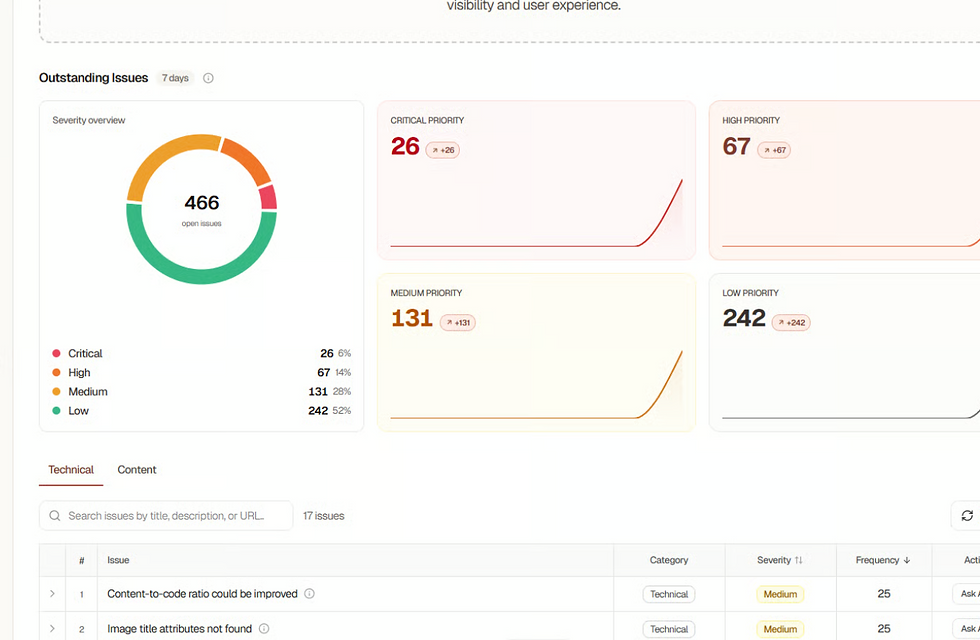
Once we've run through all five areas, we compile the findings into a clear report. Here's an example of the kinds of things we typically surface for a small service-based business:
Area | Typical Finding |
Brand Mentions | Not appearing in any AI engine responses for core service queries |
Citation Sources | Listed on Google Business Profile only; missing from key directories |
Content Structure | Homepage copy is descriptive but contains no direct Q&A or FAQ content |
Structured Data | No schema markup present on any page |
E-E-A-T | No third-party reviews; About page lacks credentials or specific experience |
The report doesn't just flag problems. For each finding, we include a plain-English explanation of why it matters and a priority rating (quick win, medium effort, or longer-term build) so you know where to focus first.
Is the Audit Worth It?
We built the audit to be useful whether or not you go on to work with us. You'll walk away with a clear picture of where you stand, a prioritised list of what to fix, and enough plain-English explanation that you could hand it to a developer or tackle the quick wins yourself.
For £97, it's a low-risk way to find out whether your business is visible in the places your customers are increasingly searching first.
If the audit uncovers issues you'd rather not tackle alone, our AI Foundations plan starts at £179/month and covers implementation, content, and citation building as an ongoing service. No contracts, no lock-in.
Ready to find out where you stand? Book your AI Visibility Audit here.
Comments